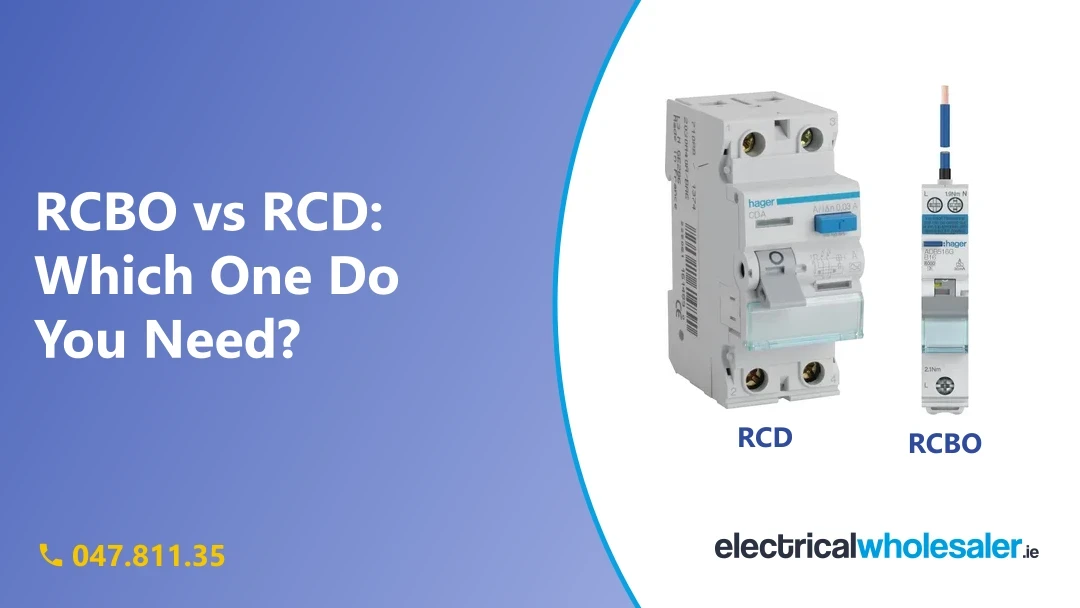
RCBO vs RCD: Which One Do You Need? (Irish Guide)
RCDs and RCBOs both trip when current leaks to earth. The difference is what else they do, and how much of the house goes off when one trips. This guide covers what each device does, how they are rated, and where each fits on an Irish board.
In Ireland, installations are designed to I.S. 10101, the National Rules for Electrical Installations, not to the UK’s BS 7671. NSAI published I.S. 10101:2020 in March 2020, and new installations have had to be designed to it since 1 February 2021. Amendment A1 was published in September 2024, and the current edition is I.S. 10101:2020+A1:2024/AC2:2025.
This is a general product overview, not installation or design guidance. I.S. 10101 and the manufacturer’s datasheet are the authority on selection and installation. Work on a distribution board in a home is Restricted Electrical Works and must be carried out by a Safe Electric Registered Electrical Contractor.
MCB, RCCB and RCBO: what each one does
- MCB (miniature circuit breaker). Protects a circuit against overload and short circuit. It does not detect earth leakage.
- RCCB (commonly called an RCD). Monitors the current flowing on the circuits it covers. If current goes astray, for example through a person, it disconnects within milliseconds. It gives no overload protection, so on a split-load board one RCCB feeds a group of MCBs.
- RCBO. Combines the two in one device: earth leakage protection and overcurrent protection for a single circuit. Hager points out that an RCBO takes up less space than a separate RCD and MCB.
Strictly, an RCBO is also a type of RCD. On the counter, “RCD” usually means the RCCB that protects a bank of circuits.
Quick comparison
| MCB | RCCB (RCD) | RCBO | |
|---|---|---|---|
| Overload and short-circuit protection | Yes | No, needs MCBs after it | Yes |
| Earth leakage protection | No | Yes | Yes |
| Circuits covered | One | Usually a group | One |
| Trip curve (B, C) | Yes | Not applicable | Yes |
| RCD type (A, F, B etc.) | Not applicable | Yes | Yes |
Reading the ratings
- Current rating (e.g. 6A, 16A, 32A, 40A). What the circuit is designed to carry. The electrician chooses it to suit the cable and the load.
- Trip curve. Safe Electric gives Type B as general purpose, with instantaneous tripping at 3 to 5 times rated current (In), and Type C at 5 to 10 times In. The curve letter is part of the device name, for example “B-10A” or “C-16A”.
- Breaking capacity. The fault current the device can safely interrupt. The rating is on the device and its datasheet. For example, Hager’s MBN132W MCB and ADB516G RCBO are both rated 6kA.
- Sensitivity. For the RCD part, 30mA is the usual rating for additional protection. I.S. 10101 now requires it on domestic lighting circuits (Rule 411.3.4). Other ratings are used for particular jobs. Since the 2024 amendment, Rule 551.9.3 allows RCD protection of up to 100mA on small microgeneration systems, such as PV systems under 5kW. Before that it had to be 30mA.
Don’t confuse a B curve with a Type B RCD. The first is about overcurrent tripping, the second about the kind of leakage current detected. An RCBO can be both B curve and Type A.
RCD types: AC, A, F and B
The type tells you what kind of leakage current the device can detect.
- Type AC: AC sinusoidal residual current only. Safe Electric’s summary of I.S. 10101 changes states that Type AC RCDs are not recommended in new installations (Clause 531.3.3).
- Type A: everything Type AC detects, plus pulsating DC. Hager Ireland lists it for loads such as washing machines that are not frequency-controlled, induction hobs, and EV charging where the charger has built-in 6mA DC fault detection.
- Type F: everything Type A detects, plus high-frequency residual current.
- Type B: everything Type F detects, plus smooth DC. Hager Ireland lists it for PV, speed-control inverters and EV charging where DC fault current can be over 6mA.
For an EV charger, the charger’s documentation states whether 6mA DC fault protection is built in. That decides whether Type A or Type B is needed on the circuit. Part 722, which covers EV charging, was also changed in the 2024 amendment.
Lighting circuits and RCD protection
Rule 411.3.4 requires additional protection by an RCD of not more than 30mA on a.c. final circuits supplying luminaires in domestic premises.
Safe Electric says the ideal way to meet this rule is a separate RCBO on each lighting circuit. Hager Ireland’s guide suggests a separate 6A RCBO for upstairs and downstairs lighting, and not mixing lighting and socket circuits on the same RCD.
The Rules require RCD protection in other places too, and your electrician designs to the full text. Installations wired to earlier editions may not meet the current Rules in every respect, which doesn’t necessarily mean they are unsafe.
Split-load board or all-RCBO board
Split-load board. One or more RCCBs each protect a group of MCBs. An earth fault on one circuit trips the RCCB, and every circuit behind it goes off. Spreading circuits sensibly across the RCCBs limits how many are affected.
All-RCBO board. Each outgoing circuit has its own RCBO, so an earth fault only takes out that one circuit, and it’s obvious which circuit has the fault.
Mixed boards. Many boards use RCBOs for some circuits, such as lighting, and RCCB-protected groups for others.
Pole configurations
Every single-phase RCBO needs its neutral connected, whatever its width, so go by the datasheet, not the size. Examples from the Hager range we sell:
- 1P+N, one module (17.7mm). Hager ADB516G, B16, 6kA, Type A.
- 1P+N, two modules (35mm). Hager AD916J, B16, 6kA, Type A.
- 4P, four modules (71mm). Hager ADM420C, B20, 6kA, Type A, for three-phase circuits.
Check the RCBO is approved for the board it’s going into.
Who can fit them
In a home, modifying or replacing a distribution board and installing or replacing circuits are Restricted Electrical Works. Safe Electric defines these as works “that can only be carried out and must be certified by a Registered Electrical Contractor (REC)”. Swapping an MCB for an RCBO in a house is a job for a registered contractor, not DIY.
FAQ
What is a 40 amp RCBO used for? A single circuit designed for up to 40A that needs both overcurrent and earth leakage protection. The appliance manufacturer’s instructions give the protective device rating for each model, and the electrician sets it to suit the appliance, cable and installation.
Can I replace an MCB with an RCBO? Often, if the RCBO is compatible with the board and matches the circuit’s rating, curve and breaking capacity. In a home it’s work on the distribution board, so a Safe Electric registered contractor must do it.
Is an RCBO better than an RCD? An RCBO protects one circuit against overcurrent and earth leakage, so a fault only trips that circuit. An RCCB protects a group of circuits against earth leakage and needs MCBs after it. An electrician will pick based on the board and the circuits.
Do I need a Type A or Type AC RCBO? Type AC is not recommended in new installations. Type A also detects pulsating DC, which suits most modern appliances. Some EV chargers and PV systems need Type B, so check the equipment instructions.
Why does my RCD keep tripping? It has detected an imbalance, usually current leaking to earth on one of the circuits it protects. Safe Electric notes it can also be a sign that the insulation in the wiring or an appliance is breaking down. Have a registered electrical contractor find the cause rather than resetting it again and again.
more
Trade insight

SEAI Grant Changes October 2026: Solar PV, the New €600 Battery Grant and Heat Pumps
What changed in SEAI grants from 6 October 2026: solar PV for homes built before 2025, the new €600 battery grant, €2,000 boiler scrappage with heat pumps and 45% for business solar PV. Correct as of 6 October 2026.
Read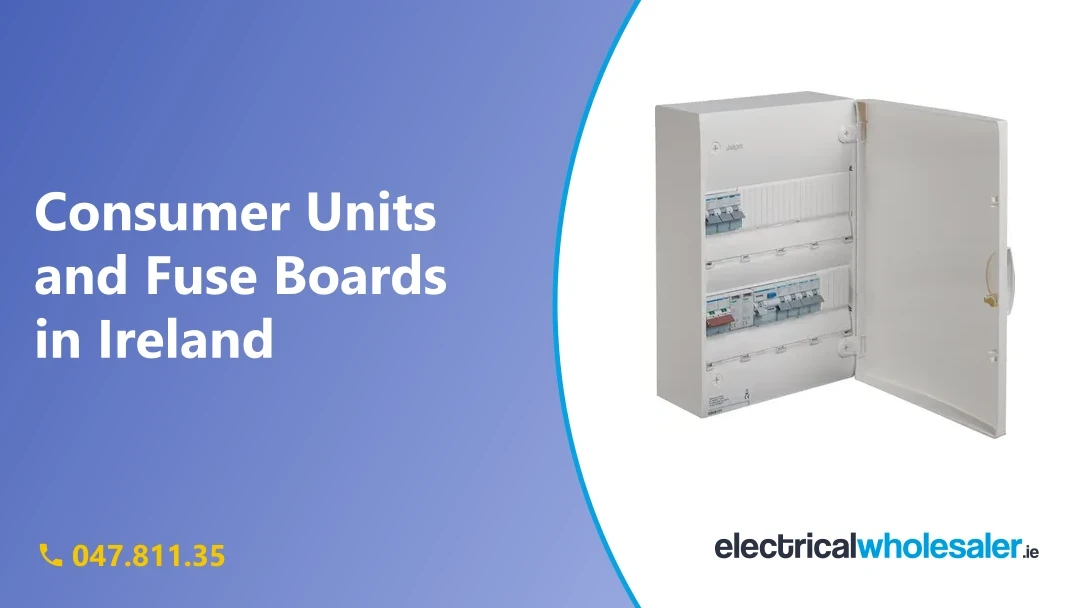
Consumer Units and Fuse Boards in Ireland: Choosing a Board, Including Garages and Outbuildings
Fuse board, consumer unit or distribution board: how to size one, what IP30, IP40 and IP65 mean, where surge protection comes in, and what Irish rules say about boards in garages and outbuildings.
Read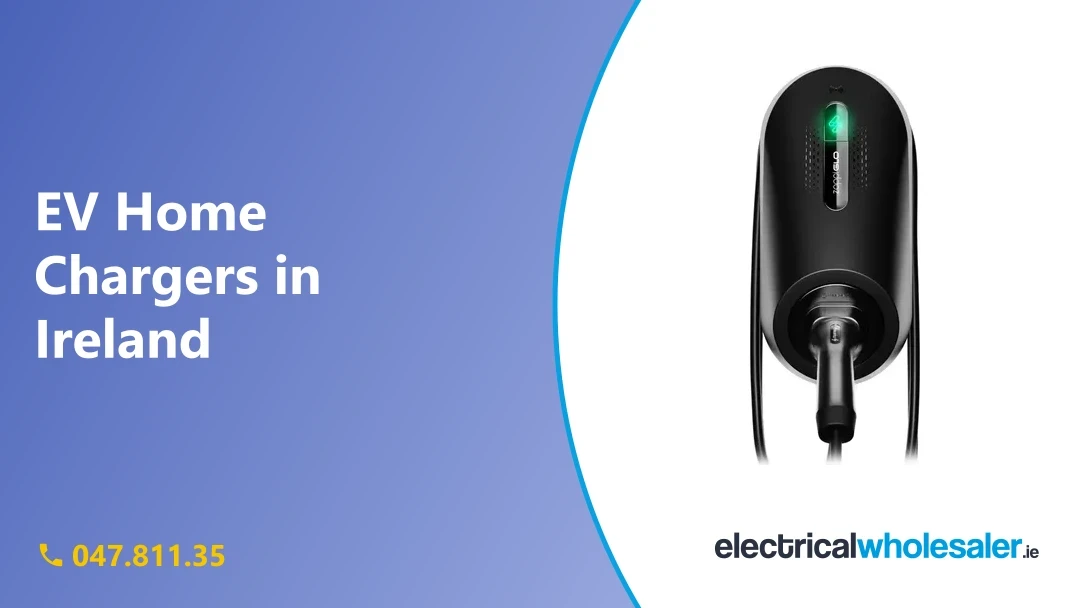
EV Home Chargers in Ireland: SEAI Grant, Choosing a Charger and Installation
How the €300 SEAI home charger grant works, how to choose between 7kW and 22kW or tethered and socketed, and what a compliant Irish installation involves. Correct as of October 2026.
Read