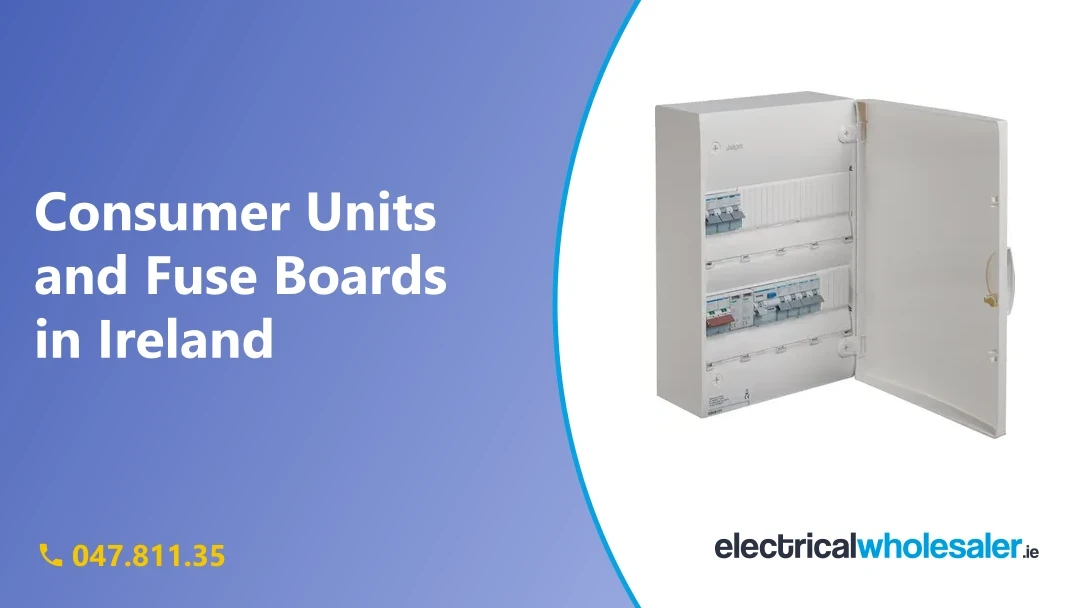
Consumer Units and Fuse Boards in Ireland: Choosing a Board, Including Garages and Outbuildings
People at our counter ask for a fuse board, a consumer unit or a distribution board. Irish law treats all three as the same thing. S.I. No. 264 of 2013 defines a distribution board as a “consumer unit or fuse-board” holding two or more fuses or circuit breakers that feed final circuits or other boards.
This guide covers who can fit one, how boards are sized, what the IP rating means, and what to think about when a garage or shed needs its own board.
This is a general product overview, correct as of October 2026. It is not installation guidance. I.S. 10101 and the manufacturer’s instructions are the authority on how a board is selected and fitted. Clause references are from I.S. 10101:2020 as summarised by Hager Ireland; the current edition is I.S. 10101:2020+A1:2024 (with the 2025 corrigendum, AC2:2025). In a home, fitting or changing a board is Restricted Electrical Works and must be done by a Safe Electric Registered Electrical Contractor (REC).
Who can fit or change a fuse board
- Installing, replacing or modifying a distribution board in a home is Restricted Electrical Works under S.I. No. 264 of 2013. That includes the customer tails on either side of the main protective device.
- Only a Safe Electric REC can carry out Restricted Electrical Works. Safe Electric states that anyone doing this work without being registered faces prosecution.
- The REC must issue a completion certificate for the work. Ask for it as soon as the job is done.
- Garages and sheds count. The regulations define a domestic property as including “any part of its out-buildings or curtilage used for non-commercial purposes”. A board in a garage that isn’t used for a business is treated the same as one in the hall.
- Farm work is different. Electrical works on agricultural and horticultural installations are excluded from Restricted Electrical Works, but they must still comply with I.S. 10101 (Section 705). Farm jobs also need a Supplementary Agricultural Certification Form, signed by the contractor, to go with the completion certificate. The Department of Agriculture’s farm building specification (S101) says both must be given to the Department before grant aid is finally certified. The farmhouse itself is still a domestic property.
Sizing: rows, modules and spare ways
Boards are sold by rows and modules. Each device takes one or more modules.
A “3 row Hager board” can mean quite different sizes:
- Hager Vega VB318J: surface, 3 rows, 54 modules
- Hager Volta VF9101SPD: recessed, 3 rows, 36 modules
Go by the module count, not the row count.
A pre-wired board also has devices fitted before you add a single circuit. The Gamma SBE8101SPD, for example, comes with an RCD, two 6A lighting RCBOs and surge protection already on the rail.
I.S. 10101 (clause 411.3.4) requires 30mA RCD protection on lighting circuits in homes. Hager Ireland recommends meeting this with a separate 6A RCBO each for upstairs and downstairs lighting. Our guide to RCBOs and RCDs goes into protective devices in more detail.
Our advice: list today’s circuits, add planned ones, and buy a board with spare ways.
One more limit from I.S. 10101 (clause 530.6.2.3): a wall-mounted board must be no higher than 2.15m from the floor to the top of the highest protective device.
Surface or recessed
Surface boards screw onto the wall.
- Hager Vega VB218J, VB318J and VB418J: empty surface enclosures with 36, 54 or 72 modules, IP40. Hager lists the VB218J at 90A and the VB318J and VB418J at 125A.
- Hager Gamma SBE8101SPD: 26 modules, IP40, 63A.
- Garo surface consumer units: 18, 24, 36 and 54 module versions, pre-wired with a main isolator, an RCD, two RCBOs and surge protection. Garo also makes versions with a main MCB instead of an isolator, so check the code.
Recessed boards sit into the wall.
- Hager Volta VU12IE, VU24IE and VU48IE: empty flush enclosures with 12, 24 and 48 modules, IP30, 63A. Hager gives the built-in depth as 90mm.
- Hager Volta VF8101SPD (24 modules) and VF9101SPD (36 modules): flush consumer units with surge protection, IP30.
Pre-wired or empty
A pre-wired board arrives with an RCD and some RCBOs already fitted. An empty board such as the Volta VU range lets the electrician choose every device.
Either way, I.S. 10101 (clause 462.5) requires the main isolator in a household to break both live and neutral on a single-phase supply. Hager Ireland notes this also applies where the enclosure for the main overcurrent device in the ESB Networks meter cabinet has earth and neutral terminals.
Surge protection (SPDs)
I.S. 10101 (section 443) sets out when protection against transient overvoltage is needed. Hager Ireland’s summary:
- It is required where the result of an overvoltage could be serious injury or loss of life, interruption of public services, damage to cultural heritage, interruption of commercial or industrial activity, or effects on a large number of people in one place.
- In other cases a risk assessment must be done. If there is no risk assessment, protection is required.
- For a single dwelling, the assessment looks at whether the total value of the installation and the equipment in it justifies surge protection.
In Hager’s words: “SPDs are required unless a risk assessment is performed and determines otherwise.” Many pre-wired boards have an SPD fitted, including the Hager Gamma SBE8101SPD, the Hager Volta SPD models and Garo’s surge-protected consumer units.
IP ratings: what the numbers mean
The IEC’s IP code has two numbers. The first rates protection against solid objects, from 0 (none) to 6 (no dust gets in). The second rates protection against water, from 0 (none) to 9.
Using the EN 60529 (IEC 60529) definitions, as tabulated by LAPP:
- IP30: keeps out objects of 2.5mm and above. No protection against water.
- IP40: keeps out objects of 1.0mm and above. No protection against water.
- IP54: dust-protected (some dust may get in, but not enough to affect safe operation). Protected against water splashed from any direction.
- IP65: dust-tight. Protected against jets of water from any direction.
So an IP30 or IP40 board has no water rating at all.
Garages and outbuildings
A non-commercial outbuilding is part of the domestic property, so a new circuit and board there are Restricted Electrical Works. The usual setup is a circuit from the house board to a separate board in the outbuilding. The cable, protective device, earthing and RCD arrangement for that supply are the REC’s design decisions under I.S. 10101.
On the enclosure itself:
- The rating needed is the REC’s call, based on the conditions in the building.
- Where damp or dust is a concern, a sealed enclosure is one option. Hager’s Vector VE118R (18 modules) and VE218R (36 modules) are listed at IP65 and 63A. Hager’s product data also marks them as not suitable for outdoor use and not UV-resistant, so they go inside the building, not on an outside wall.
- For a small feed in a dry building, Hager’s Mini enclosures GD106N (6 modules, 50A) and GD110N (10 modules, 63A) are IP30, so they have no water rating.
For timber buildings, I.S. 10101 (clause 421.7) recommends arc fault detection devices (AFDDs) in locations with combustible building materials, such as wooden buildings. It also recommends them in places storing combustible materials, such as barns and woodworking shops, and in premises with sleeping accommodation. Hager notes that an AFDD, where used, goes at the origin of the circuit it protects.
Two electric showers: non-priority boards
Garo lists the CV8-NPS as a “1 Row Shower Non Priority Board”. Garo’s spec sheet says both showers can run at under 3kW each. When one goes above that, the board automatically cuts power to the other shower to protect the main supply fuse. Check the product instructions for the exact wiring and ratings.
FAQs
What size consumer unit do I need? Enough modules for today’s circuits, planned ones, and the RCD, lighting RCBOs and SPD a pre-wired board already carries, with spare ways on top. Two 3-row boards can differ by 18 modules, so compare module counts.
Do I need an IP65 board in a garage? Not always. Your REC decides from the conditions. A damp or dusty garage may need better sealing than IP30 or IP40, which carry no water rating. Hager lists its IP65 Vector enclosures as not suitable for outdoor use.
Can I change my own fuse board in Ireland? No. Replacing or modifying a distribution board in a home is Restricted Electrical Works. It must be done and certified by a Safe Electric REC.
Does a new fuse board need surge protection? Under I.S. 10101, surge protection is required unless a risk assessment shows otherwise. For a single house, that assessment weighs the value of the installation and the equipment in it.
What is a non-priority shower board? It lets two electric showers share one supply without overloading the main fuse. On Garo’s CV8-NPS, both showers can run at under 3kW each; if one draws more, the board cuts power to the other.
more
Trade insight
SEAI Grant Changes October 2026: Solar PV, the New €600 Battery Grant and Heat Pumps
What changed in SEAI grants from 6 October 2026: solar PV for homes built before 2025, the new €600 battery grant, €2,000 boiler scrappage with heat pumps and 45% for business solar PV. Correct as of 6 October 2026.
Read
EV Home Chargers in Ireland: SEAI Grant, Choosing a Charger and Installation
How the €300 SEAI home charger grant works, how to choose between 7kW and 22kW or tethered and socketed, and what a compliant Irish installation involves. Correct as of October 2026.
Read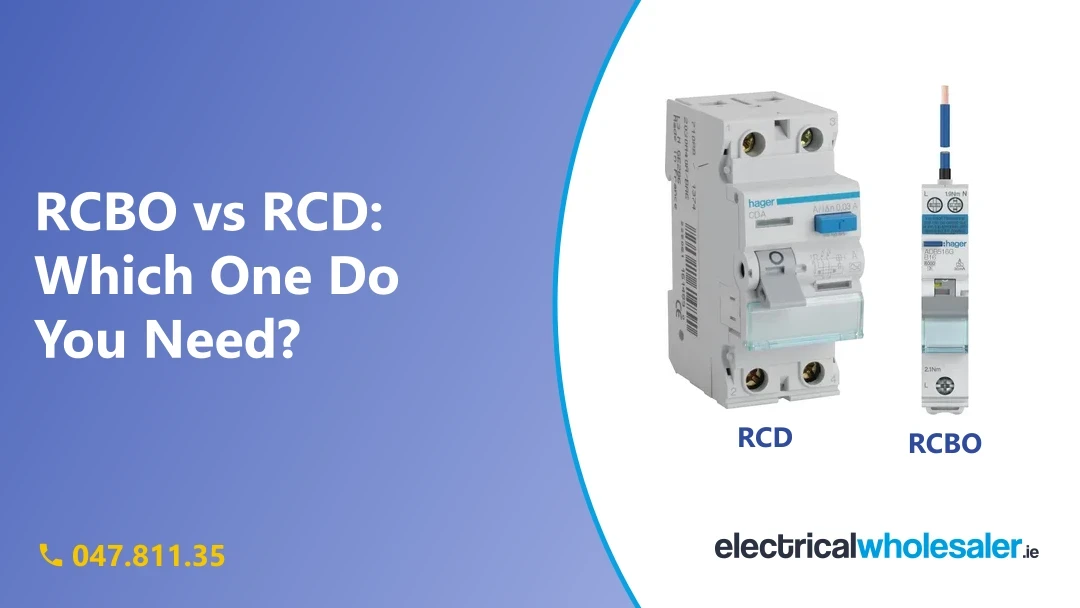
RCBO vs RCD: Which One Do You Need? (Irish Guide)
RCDs and RCBOs both trip on earth leakage, but only an RCBO also protects a single circuit against overcurrent. How they differ, how they are rated and where each fits under I.S. 10101.
Read