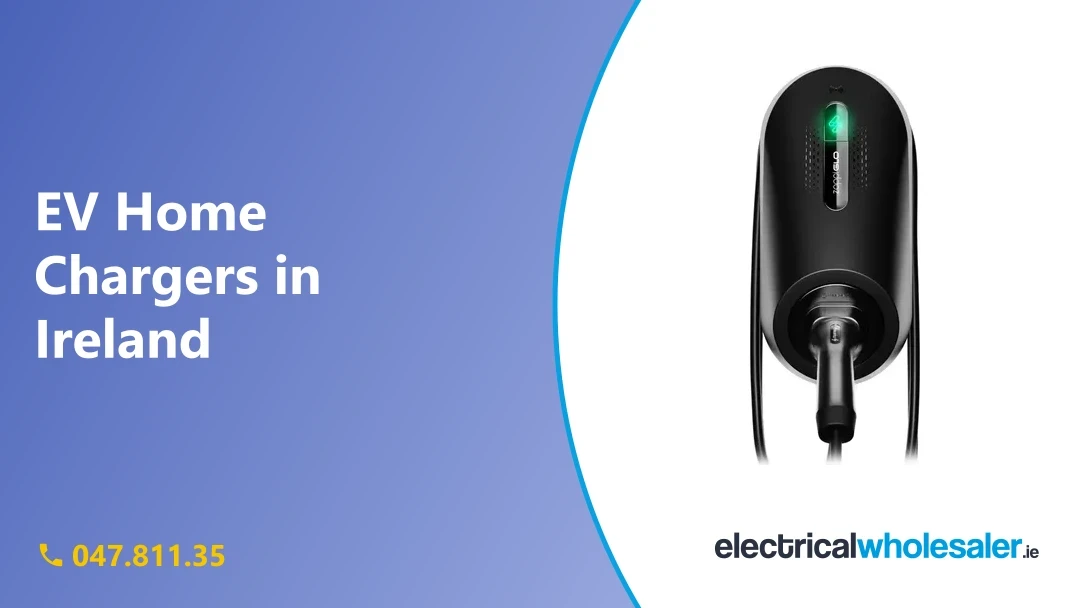
EV Home Chargers in Ireland: SEAI Grant, Choosing a Charger and Installation
A home charger is the easiest way to keep an EV topped up. It’s also a permanent electrical installation, and the grant has its own rules. Here’s how the SEAI grant works, what to look at in a charger, and what the install involves.
This is a general overview, correct as of October 2026. seai.ie, Safe Electric and the charger manufacturer’s instructions are the authority on grant terms, installation rules and product details.
The SEAI EV Home Charger Grant
SEAI pays up to €300 (correct as of October 2026) towards buying and installing a home charger. It covers 100% of the cost up to that figure, charger and installation together, and you need invoices for both.
- Homeowners and residents can apply, whether or not they own an EV yet.
- The grant beneficiary must be a private individual.
- The property must be a private residence with its own private off-street driveway. The charger, the work and the driveway must all be inside the property boundary.
- Only one charger can be linked to the property’s MPRN.
- The property can’t have had a previous EV home charger grant, or the free ESB ecars home charger before 2018.
- The charger must be on SEAI’s approved list of smart chargers. SEAI publishes the list in the FAQs on its EV Home Charger Grant page and in the online application form. Check the exact model before you buy. Being on SEAI’s wider Triple E register is not enough.
Apartments and multi-unit developments without dedicated private off-street parking come under SEAI’s separate Apartment Charger Grant, applied for by the management company, local authority or housing body. If you have assigned parking in a development that has taken part in the Apartment Charger Scheme, you may be able to apply for the Home Charger Grant yourself.
The government’s 29 September 2026 package of enhanced SEAI grants, effective 6 October 2026, covers solar PV, batteries, insulation, boiler scrappage and business supports. It lists no change to the EV home charger grant. Check seai.ie before you apply.
Apply first, then install
- Don’t start any work before the start date on your Letter of Offer. SEAI treats earlier spending as ineligible.
- You have 6 months from the Letter of Offer to finish and return the Payment Request Form.
- The claim needs the signed form with your bank details, the Cert 3, the test record sheet, the invoices and photos of the installed charger.
- Your electrician must file the Cert 3 with Safe Electric. SEAI checks this before it pays.
- If you apply yourself, the grant is paid into your own bank account, not the electrician’s. SEAI says payment usually takes about 4 to 6 weeks from receiving the documents.
If the electrician finds the house needs a better earth connection, bigger meter tails or improved bonding first, SEAI does not grant-aid those upgrades.
7kW or 22kW?
SEAI explains that home chargers typically come in 16 amp and 32 amp sizes, giving 3.7kW and 7.4kW maximum. A charger sold as “7kW” or “7.4kW” is the 32A single-phase size. That covers the zappi 7kW, the Sync EV 7.4kW models, the GARO GEV7.4L and the Hager witty one on a single-phase supply.
Grant check: as of 6 October 2026, zappi, GARO GEV 7.4 and BG Sync EV models appear on SEAI’s grant product list. The Hager witty one is registered on SEAI’s Triple E register but is not yet on the EV Home Charger Grant list or in the application form, so it can’t currently be chosen for the €300 grant.
22kW needs three phases. myenergi says the three-phase zappi should be connected to a 400V, 4-wire, three-phase supply, and Hager lists the witty one as “22kW three-phase / 7kW single-phase”. ESB Networks describes the standard domestic connection as 12kVA single phase.
SEAI also advises checking what your car’s on-board charger can take before you choose.
Tethered or untethered?
- Tethered means the Type 2 cable is fixed to the charger. Sync EV and GARO list 7.5m on their tethered 7.4kW units.
- Untethered (socketed) chargers have a Type 2 socket and you use your own cable. Sync pitches its socket version at shared spaces and multi-vehicle homes.
One car that won’t change soon suits a tethered unit, with no lead to put away. Where cars change or visitors charge, a socket is more flexible. Budget for a Type 2 cable if you go socketed.
Load management and solar
On a standard 12kVA supply, SEAI warns that a 7kW charger on top of a power shower, oven and immersion can trip the main fuse. It recommends a charger with demand management: a clamp on the main supply cable that tells the charger to cut back or pause when the house load is high.
ESB Networks’ code of practice gives two routes for a charger up to 32A on a standard domestic connection. The electrician fits control equipment so the maximum import capacity isn’t breached, or you apply for a bigger supply.
- zappi: supplied with clip-on grid sensor(s), with an optional setting to limit current drawn from the grid.
- GARO GEV 7.4: CTs supplied for dynamic and solar load management.
- Sync EV: Sync lists CT-clamp dynamic load management on its commercial 4G/RFID wall chargers (EVWC2S7GGR, EVWC2S22GGR). Sync also sells a separate CT clamp (EVA120CT1, 120A) with options for household properties. Auto Solar Charge is standard on its wall chargers.
- Hager witty one: Hager Ireland lists 7kW models supplied with a CT for load management, such as the XVU107CCT-MO.
myenergi’s datasheet describes three zappi modes. ECO mixes surplus solar with up to 1.4kW from the grid to keep the charge going. ECO+ only uses surplus that would otherwise be exported, and pauses when there isn’t enough. FAST charges at the maximum rate from any source.
RCDs and PEN protection
Mainly for electricians:
- Hager Ireland’s I.S. 10101 RCD guide lists Type A for “Electric Vehicle charging where any smooth DC fault current is less than 6 mA” and Type B where it is greater than 6mA.
- myenergi says the zappi has built-in 6mA DC protection (RDC-DD to EN 62955) and that an additional upstream Type A RCD or RCBO is required. Sync lists an integrated 30mA Type A RCD with 6mA DC detection on its 7.4kW wall chargers. GARO lists AC/DC leakage protection. Hager lists integrated DC residual current detection on the witty one.
- ESB Networks makes TN-C-S the standard earthing system for new low-voltage connections. myenergi and GARO list built-in PEN fault protection, and Sync lists integrated open PEN protection on its wall chargers.
- The earthing arrangement is still the electrician’s call under I.S. 10101 and the manufacturer’s instructions. myenergi’s manual says the zappi “must be earthed in accordance with local regulations”.
- NSAI’s I.S. 10101:2020+A1:2024 modified Part 722, Supplies for electric vehicles. Work to the current edition.
Installation: who can do it
A charger is not a DIY job. Safe Electric’s definition of Restricted Electrical Works includes installing one or more new circuits. That work can only be carried out and certified by a Registered Electrical Contractor.
SEAI recommends an electrical survey first. For a standard connection it says the meter tails should be at least 16mm², and that houses built before 2000 without major rewiring are likely to have undersized tails.
When the job is done, ask for the completion certificate straight away. Safe Electric says Certificate No. 3 covers alterations and additions to existing installations.
- ESB Networks says the standard 12kVA supply will suffice in many cases. You only contact them if you need to increase it.
- ESB Networks’ code of practice says there should be no drilling, and no EV equipment fitted, in the area directly below the outside meter cabinet.
- A Mode 2 “granny” cable is typically rated up to 13 amps, SEAI notes. Only use one from a 3-pin socket of sufficient quality and rating to carry that current for hours, and have your electrician check it. A trailing lead is also a trip hazard. SEAI recommends a permanent wall-mounted charger for home use.
FAQs
How much is the SEAI EV charger grant? Up to €300, correct as of October 2026, for the charger and fitting combined. It’s paid once SEAI has approved the paperwork.
Can I get the grant if I don’t have an electric car yet? Yes. The driveway and MPRN rules still apply.
Do I need a tethered or untethered charger? Either works. Tethered saves handling a lead. Socketed takes any compatible Type 2 cable.
Can I install an EV charger myself in Ireland? No. A new charger circuit has to be done and certified by a Safe Electric registered contractor, and the grant needs their Cert 3.
Do I need a 22kW charger? Only if you have a three-phase supply and a car that can use it. On a standard single-phase connection, 7kW to 7.4kW (32A) is the usual maximum.
Do I need to tell ESB Networks about my EV charger? Often not. If your electrician finds the 12kVA supply isn’t enough, you apply to ESB Networks to upgrade, typically to an enhanced 16kVA connection.
more
Trade insight

SEAI Grant Changes October 2026: Solar PV, the New €600 Battery Grant and Heat Pumps
What changed in SEAI grants from 6 October 2026: solar PV for homes built before 2025, the new €600 battery grant, €2,000 boiler scrappage with heat pumps and 45% for business solar PV. Correct as of 6 October 2026.
Read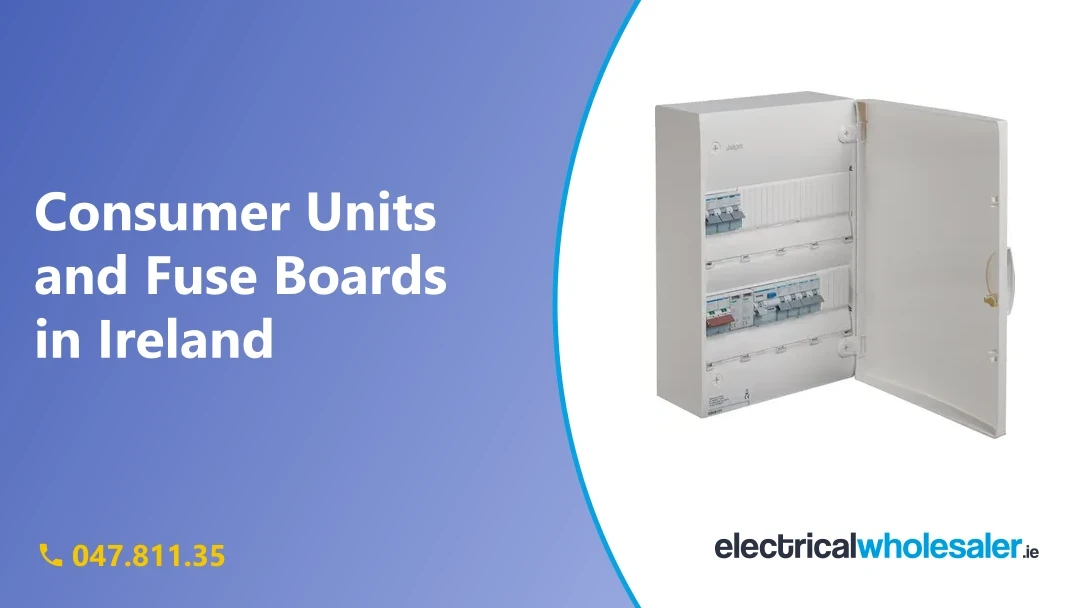
Consumer Units and Fuse Boards in Ireland: Choosing a Board, Including Garages and Outbuildings
Fuse board, consumer unit or distribution board: how to size one, what IP30, IP40 and IP65 mean, where surge protection comes in, and what Irish rules say about boards in garages and outbuildings.
Read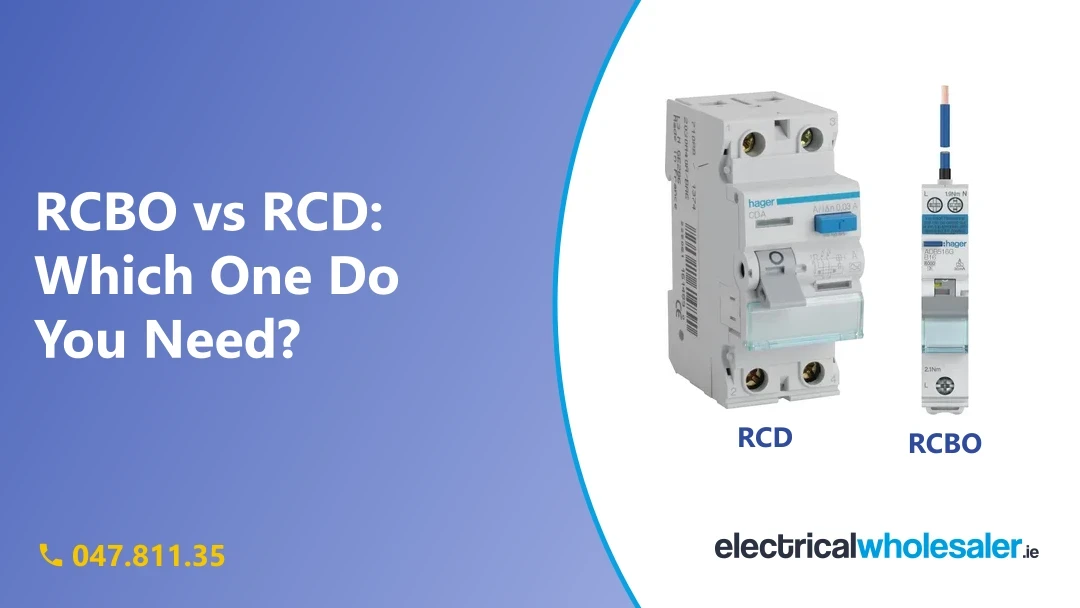
RCBO vs RCD: Which One Do You Need? (Irish Guide)
RCDs and RCBOs both trip on earth leakage, but only an RCBO also protects a single circuit against overcurrent. How they differ, how they are rated and where each fits under I.S. 10101.
Read